Completion
To have a "complete" repertoire in Chessbook, you need to cover every position that is expected to occur at least 1 in n games, where n is your coverage goal. If your coverage goal is 1 in 200 games, then completion is measuring: "Do you have a response ready for every position you're likely to see at least once every 200 games?"
What does "1 in n games" mean?
Imagine a repertoire for White consisting of just one line: 1.e4 e5 2.Nf3 Nc6. How often would you expect it to lead to this position?
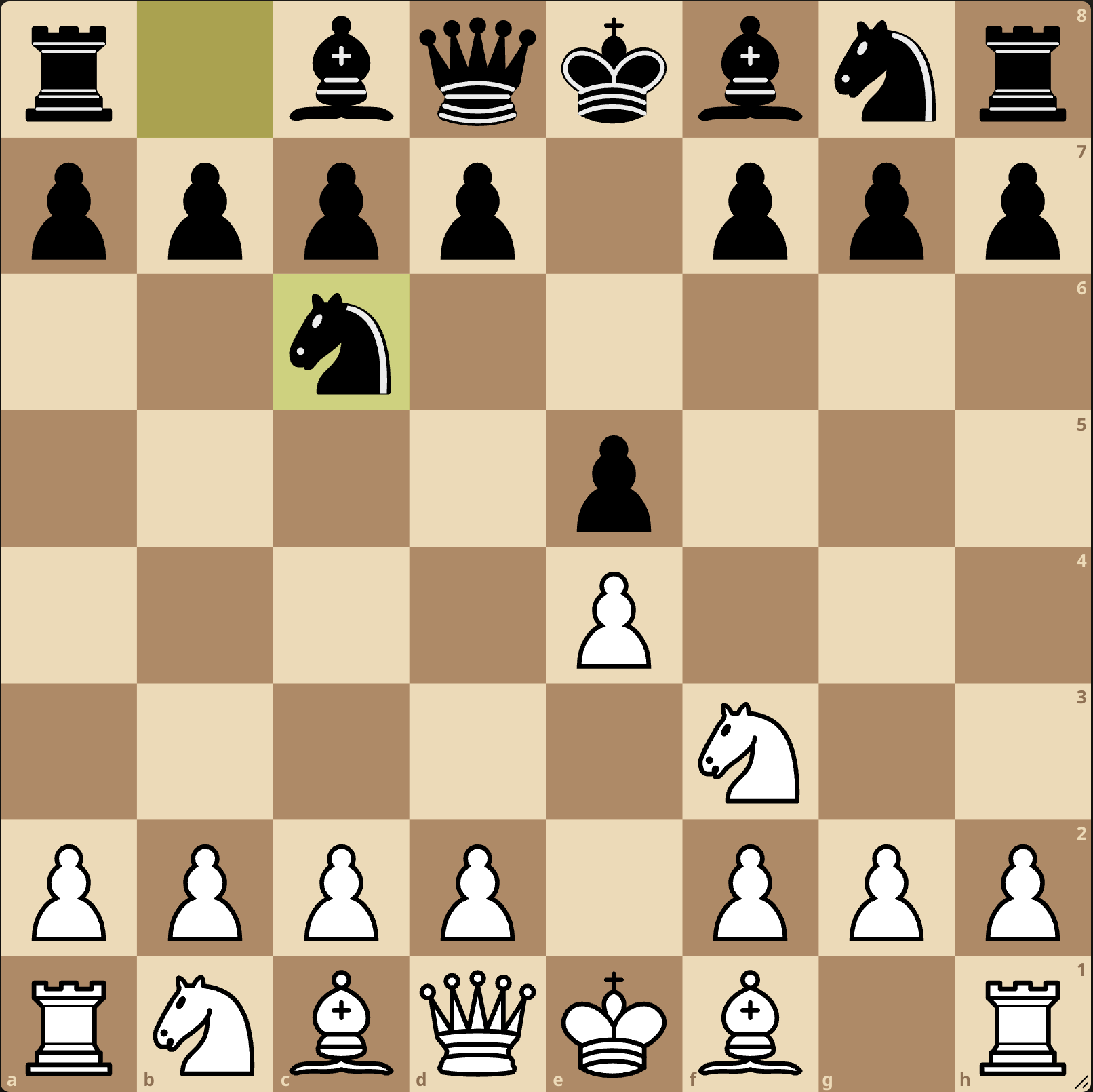
For this example, suppose each of those opponent replies is played half the time. These are illustrative numbers; Chessbook uses game data for your rating range. The calculation is:
- You'll play
1. e4100% of the time - Your opponent will play
1...e550% of the time - You'll play
2. Nf3100% of the time - Your opponent will play
2...Nc650% of the time
100% x 50% x 100% x 50% = 25% = 1 in 4 games
What should my coverage goal be?
In the example above, your repertoire ends on a position that happens in a quarter of your games. Surely you should go deeper than that, but how deep?
We argue you should keep building your repertoire until you've arrived at positions that are too rare to be worth memorizing. That exact figure varies, and you can change your coverage goal in repertoire settings, but for the sake of example, let's say you choose 1 in 200. That means you're saying "I am going to build a repertoire that has a response to every position that's expected to occur at least once in every 200 games I play".
A completion score of 100% means you have covered your chosen goal. It does not mean you have prepared for every legal move, or memorized the moves you saved. See Mastery for review progress.